
Flux Friday
Turning and Facing the Newsletter

Testing, testing 1.2.3. Mary had a little lamb…

Hey, and hello to new subscribers and regular readers—and to any irregulars, skirmishers, and fresh faces who wandered by.
Some of you might be wondering why you’re hearing from me again. I’ve changed email services, so some former subscribers are receiving this email as part of the switchover. You can stay or unsubscribe at the bottom of this message, and the e-pixies at Substack will remove you from the list.
Thank you for reading this far. If you’re interested in why, read on.
Changes
David Bowie provided a soundtrack to my youth. I read a great deal and spent too much time ‘dreaming my life away’, as my mother sang to me. During those years, I still banked ideas. I took stories in my head, turned them around, and retold them time and again. Not because they didn’t deliver the childish heroic exploits where some avatar of myself saved the day with derring-do. Rather, I wanted a story that managed this in a way that I found convincing.
Last week, I touched on the why and wherefore of this Weekly Newsletter. I post about my writing and promote other writers’ work, too. In return, they share my books in much the same way in their own emails to readers like you, who opted to subscribe.
There’s no such thing as a free lunch.
In the TV show The Waltons, set during the 1930s, John-Boy’s mom shows him an ad for a publishing company. Excited, they submit his stories and sign the contract. They don’t read the small print. The books arrive, but with a bill. It’s called vanity publishing, and John Boy shoulders the debt.
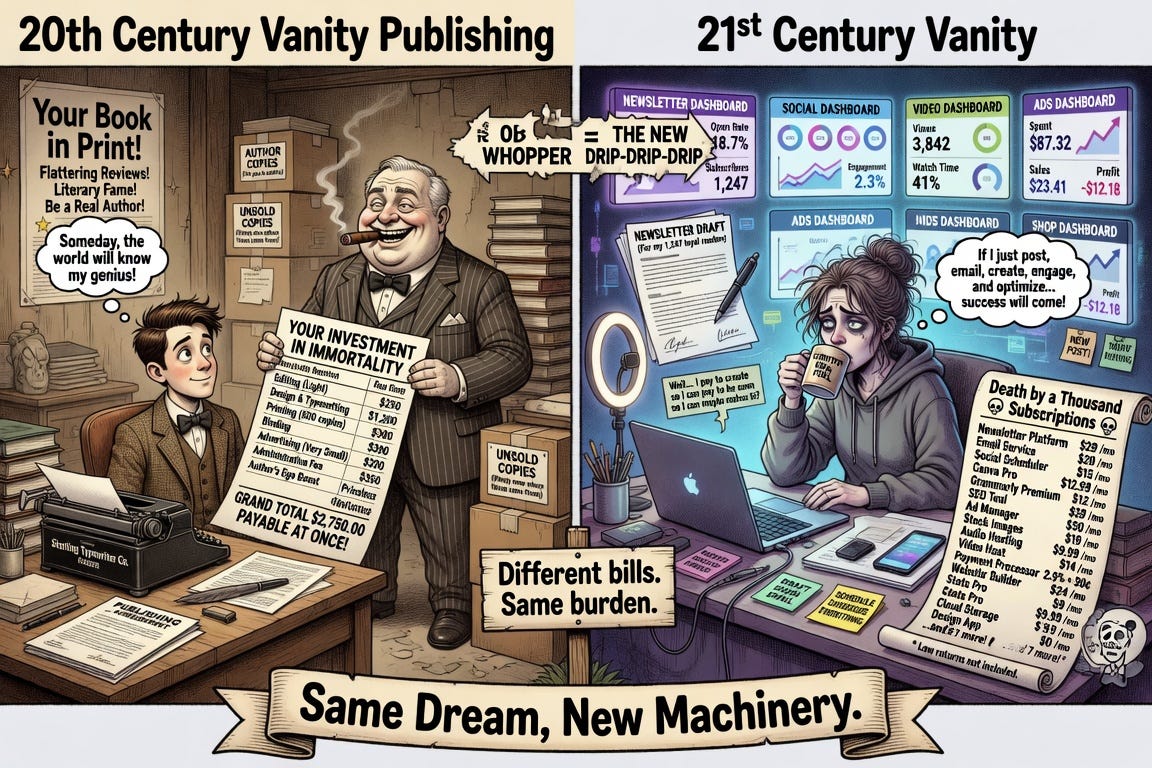
Self-publishing authors can, in the modern era, use print-on-demand and e-book marketplaces to avoid that trap, but the snare remains. A year’s subscription to this or that, and you are suddenly several hundred dollars poorer. If you are making pennies for every copy of your book, and many are, you need to sell a lot of them to cover these costs, even if, unlike John Boy, you’re not paying for the physical book’s printing run.
Most justify the gap with either a dose of hopium, or accept this is a cost-to-us hobby we enjoy. Still, I can’t help seeing these kinds of expenses as just the modern incarnation of vanity publishing.
Turn and face the strange
Simultaneous sending of hundreds of emails, even once a week, isn’t something a regular email account allows. I’ve been using the free tier of MailerLite, for over a year. When I signed up, I could send emails to up to 1,000 subscribers. I did that once a week. Starting out, I didn’t have a mailing list to speak of, and that upper limit felt aspirational.
Then things changed.
First, the free tier halved to 500 subs’. At this time, I sent around half that number. As of July 1st, it has halved again… and I’ve doubled my subscriber count in the intervening months.
Ch-ch-ch-ch-changes.
So I’m trying something different. In truth, I’ve tried a bunch of new things. While I looked at various options to replace MailerLite, a friend suggested Substack.
I’d never considered the platform as an email sender, yet that’s what it does, under the lid. Every article can be an email.
Each account can run up to ten separate publications, each with its own subscriber list. I’ve set one up specifically as a newsletter, another functions more like traditional social media, and Arthur R. King has broken the fourth wall to write about his mysterious world.

Can this work?
I hope so, and here’s why.
Marketing isn’t about selling what inventory I have. As a concept, it’s about making something, a good or service, that people want.

For making stuff up into stories that entertain, I have to engage with readers. Get a sense of what people want to read in the genres I enjoy writing, and by bringing this together, make my readers and me happier.
Let me know what you think about this, or anything at all in the comments!
Meet Lowan, a telepathic alien working as a private detective in the 1930s!

Arthur Keating spent fourteen years trying to forget the mistake he made during the war. Now working as an accountant at a chemical research facility, the numbers don’t add up. Not just the accounts, but the inventory of dangerous chemicals. When Keating receives a threatening note, Lowan is hired to help. Lowan takes Keating’s place and finds himself hounded by relentless pursuers. Keating himself disappears. Will Lowan save Keating from his past and uncover hidden fraud, or will a buried wartime error finally be paid in blood?
I'm sorry MailerLite kept changing its tiers. I hope Substack doesn't do the same, and I hope switching fully to Substack helps you. Your different publications are really interesting!